Pearson Edexcel · GCSE · Business
Course version: 1BS0 · Version from Sept 2017
Methods of business growth and their impact: ● internal (organic) growth:…
Full specification wording
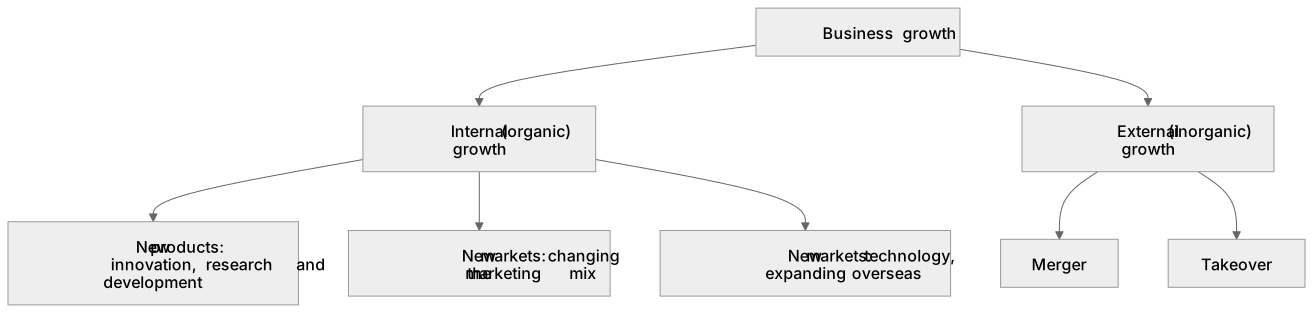
Business growth: Methods of business growth and their impact: ● internal (organic) growth: new products (innovation, research and development), new markets (through changing the marketing mix or taking advantage of technology and/or expanding overseas) ● external (inorganic) growth: merger, takeover.
Businesses grow using internal (organic) or external (inorganic) methods.
Checked against the Pearson Edexcel 1BS0 specification (opens in a new tab) on .
- Point 1 of 3
- 4 key terms
Study notes
From the checked teaching notes for this specification point.
The idea
Businesses grow using internal (organic) or external (inorganic) methods. Internal growth occurs from within, such as developing new products through innovation and rigorous research and development (R&D). Firms can also target new markets by altering their marketing mix, leveraging technology like e-commerce to reach wider audiences, or expanding overseas to capture international sales. External growth is faster and involves joining with other firms. This happens through a merger, where two companies agree to form a single new entity, or a takeover, where one business buys a controlling interest in another. While organic growth is generally lower risk and easier to manage, inorganic growth provides rapid market share expansion but carries integration risks.
What earns the marks
- Define internal growth as expansion from within the business, such as launching new products developed through R&D.
- Explain how changing the marketing mix or using e-commerce technology allows a business to access new markets and drive organic growth.
- Distinguish between a merger (a mutual agreement to join forces) and a takeover (one business acquiring control of another).
- Analyse the impact of external growth, noting that while it rapidly increases market share, it can lead to culture clashes and diseconomies of scale.
- Evaluate the risks of expanding overseas, such as language barriers or differing legal requirements, against the benefit of a larger customer base.
Common mistakes and how to put them right
Using the terms merger and takeover interchangeably.
Put it right: Specify that a merger is a mutual joining of two businesses, whereas a takeover involves one business buying another.
Stating that internal growth is always fast.
Put it right: Explain that organic growth through R&D and innovation is typically a slow, gradual process compared to external growth.
Forgetting to link technology to new markets.
Put it right: Explicitly state how technology, such as a new app or website, allows a business to reach customers outside its traditional geographical area.
Exam tips
- When evaluating growth methods, contrast the slow, lower-risk nature of organic growth with the rapid, higher-risk nature of inorganic growth.
- Use the specific terms 'innovation' and 'research and development' when discussing how a business creates new products to achieve internal growth.
- If a case study mentions a business buying another, explicitly identify this as a takeover and discuss the potential impact on the workforce.
Try the lesson
The start of the Business growth: Methods of business growth and their impact: ● internal (organic) growth: new products (innovation, research and development), new markets (through changing the marketing mix or taking advantage of technology and/or expanding overseas) ● external (inorganic) growth: merger, takeover. lesson, made from checked teaching notes for this specification point.
Have a go first
Which of the following is an example of internal (organic) business growth?
Listen
Businesses grow using internal (organic) or external (inorganic) methods. Internal growth occurs from within, such as developing new products through innovation and rigorous research and development (R&D). Firms can also target new markets by altering their marketing mix, leveraging technology like e-commerce to reach wider audiences, or expanding overseas to capture international sales. External growth is faster and involves joining with other firms. This happens through a merger, where two companies agree to form a single new entity, or a takeover, where one business buys a controlling interest in another. While organic growth is generally lower risk and easier to manage, inorganic growth provides rapid market share expansion but carries integration risks. A strong answer earns marks for these points. Define internal growth as expansion from within the business, such as launching new products developed through R&D. Explain how changing the marketing mix or using e-commerce technology allows a business to access new markets and drive organic growth. Distinguish between a merger (a mutual agreement to join forces) and a takeover (one business acquiring control of another). Analyse the impact of external growth, noting that while it rapidly increases market share, it can lead to culture clashes and diseconomies of scale. A common slip: Using the terms merger and takeover interchangeably. Instead, specify that a merger is a mutual joining of two businesses, whereas a takeover involves one business buying another. Exam tip: When evaluating growth methods, contrast the slow, lower-risk nature of organic growth with the rapid, higher-risk nature of inorganic growth.
See it
Key words
Say what each word means before you turn the card.
Internal (organic) growth
Try answering aloud or in your head before turning the card.
Merger
Try answering aloud or in your head before turning the card.
Takeover
Try answering aloud or in your head before turning the card.
External (inorganic) growth
Try answering aloud or in your head before turning the card.
See every definition
- Internal (organic) growth
- Expansion from within the business, such as launching new products developed through innovation and research and development.
- Merger
- Two companies agree to form a single new entity.
- Takeover
- One business buys a controlling interest in another.
- External (inorganic) growth
- Growth that is faster and involves joining with other firms through a merger or takeover.
Label the diagram
Some boxes have lost their names. Pick the right name for each number.
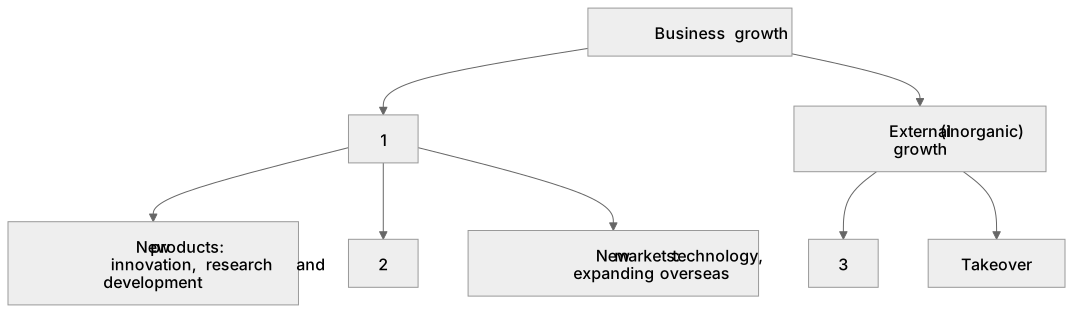
1Box 1
2Box 2
3Box 3
There is more to this lesson
The full lesson goes on to check your understanding and help you earn the marks. Create a free account to carry on, with your progress saved.
A week of Premium from your first lesson · Then the free plan continues · No card, no charge
Test your understanding of Business growth: Methods of business growth and their impact: ● internal (organic) growth: new products (innovation, research and development), new markets (through changing the marketing mix or taking advantage of technology and/or expanding overseas) ● external (inorganic) growth: merger, takeover.
Active recall beats re-reading. Take an instant quiz now to test what you’ve learned and lock it into long-term memory.
A week of Premium from your first lesson · Then the free plan continues · No card, no charge